Soundproofing: best practices for winning the war against noise
Jan 17, 2017
Marcel LapierreWhether you live in a triplex or a single-family home, you may often be bothered by noise coming from upstairs or downstairs or through the walls. From the sound of a chair on a floor to music being played too loudly, annoying noises heard through floors and walls due to poor acoustic insulation can disrupt your peace of mind and, in some cases, become a daily nightmare.
What can you do to control these noises and regain your precious peace and quiet?
You may be surprised to learn that there are some relatively easy ways to improve soundproofing in your house. First, however, some useful definitions.
Sound is vibrations travelling through the air that can be heard when they reach a person’s or animal’s ear. It is described in terms of its frequency (measured in Hertz) and intensity (measured in decibels).
Noise is any undesirable sound, according to a listener’s subjective perception. It is also measured in decibels. What makes noise distinctive is that it is a sound perceived as bothersome.
This is the unit used to measure the intensity of a sound on a scale. For example, the sound level of an airplane taking off is approximately 130 dB, while that of a whisper is just 20 dB.
As you have likely guessed, this is indoor or outdoor noise that travels through the air, making the partitions (walls, floors or ceilings) in your home vibrate before finally reaching your ears. It has no direct contact with the building’s structure.
This type of noise includes:
Sound Transmission Class (STC) is a rating of how well a building’s structural components attenuate airborne noise. The higher the STC of a wall or floor, the more effective its sound deadening properties. The National Building Code prescribes an STC of at least 50 dB, and even greater in some cases.
Impact noise is a structure-borne sound, meaning that it is transmitted through contact with a structural component, and may be individual sounds or a vibration.
This type of noise includes:
Impact Insulation Class (IIC) is a rating used to indicate how effectively floors and ceilings attenuate impact noises. This rating is also measured in decibels (dB). It should be noted, however, that the National Building Code does not prescribe specific criteria with regard to impact noise.
As mentioned previously, there are some relatively simple ways to enhance the soundproofing of the floors, walls or ceilings in your home. However, before proceeding with any work, be sure to review the following 5 items:
1. What noise do you hear, and where is it coming from?
2. Is it possible to reduce the noise at the source?
3. Can you identify any openings (plumbing, electricity, etc.) in the floor that are letting air through and helping to transmit the sound?
4. Do you have any flush-mounted light fixtures for which multiple holes had to be made in the ceiling to attach them? The sound may be sneaking in through the holes!
5. Do you use draperies to decorate your home’s interior? Do you have carpeting on your floor? Thick rugs and fabrics – like velvet – are excellent soundproofing materials!
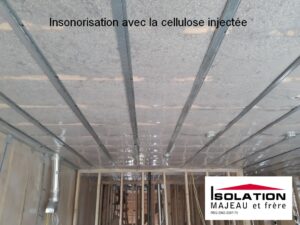
Cellulose blown between floors in a residence via the ceiling.
If you want to enjoy superior soundproofing in your new home, consider using a combination of the following materials based on the degree of soundproofing you require:
Through the CALI System, partitions are suspended from a building’s framework using resilient metal channels to enhance the sound deadening properties of the ceilings. And to improve soundproofing in your home even more, you can always have cellulose blown into your walls!
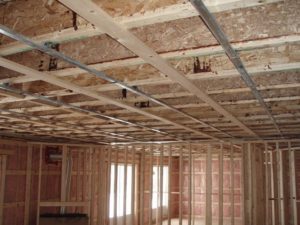
Système CALI
CALI System
Do you want to learn more about best practices in residential soundproofing? Consult the APCHQ’s guide to building acoustics (available in French only) by clicking the image below or call us toll-free at 1-888-962-5328.

Marcel Lapierre is president of Isolation Majeau et frère. He worked previously for more than 18 years in plastics and other major industries as a plant manager. Marcel went on to found his own consulting firm specializing in business development and process improvement.
Marcel has spearheaded numerous business development initiatives at Isolation Majeau since 2011, including deployment of the company’s new website and management of its social media presence. With his extensive experience in corporate management, he has wasted no time making improvements to business processes with a focus on efficiency and outstanding customer service.