Basement slab insulation: for greater energy efficiency
Jun 06, 2016
Marcel LapierreWho hasn’t at some point noticed a damp smell when going downstairs to their basement? While this appears to happen to many homeowners, it is never a good sign! This musty or wet-earth odour is caused by the presence of excessive moisture, which can promote the growth and spread of mould. And with mould comes poor indoor air quality and potential adverse effects on the respiratory health of your home’s occupants.
However, there is one sure way to permanently eliminate – or better yet, prevent altogether – problems with moisture in your basement: by insulating and sealing the underside of the concrete floor slab.
Effective August 30, 2012, the Quebec Construction Code based on the National Building Code (NBC) has made insulating the undersides of slabs mandatory in all new construction. Additionally, the system must act as both an air and vapour barrier. These new standards are part of an energy strategy and action plan for climate change targeting reduced energy consumption in households across the province.
This means that if you’re planning to build a new home, you must comply with the new regulations governing energy efficiency when it comes to insulating the underside of your basement slab. You have three options in this regard:
Recommended by contractors, full-surface insulation creates a perfect seal between the slab and the foundation walls, primarily when it is laid using spray urethane foam, an insulation material known for its clearly superior thermal performance.
Insulate the foundation walls and joist spaces using spray urethane foam. The result will be uniform, joint-free insulation from slab to joist.
Another option you might consider is to apply a single layer of urethane underneath the slab and to the foundation walls and joist spaces. The contractor can then proceed with pouring the cement and erecting the partitions.
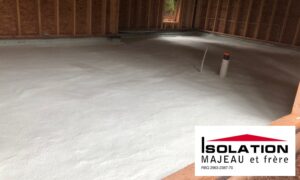
Since the importance of proper basement insulation was recognized only relatively recently, it is highly likely that your concrete floor slab may require sealing. If the height of your basement permits, you could apply 1 inch of urethane to the existing slab and then pour a new concrete slab offering the target properties:
Other options are possible for insulating a concrete floor slab, but it is very difficult to:
When pouring the slab, it’s also important to anticipate that the workers will have to tread on the prepared surface, potentially damaging the styrofoam sheets and polyethylene vapour barrier. For this reason, we recommend insulating with spray urethane foam, which is practically impossible to damage due to its high compressive strength (28 psi).
Your basement is a high-risk area that can generate a good amount of moisture, condensation and mildew in addition to causing significant heat and energy loss. Insulating your basement slab and foundation walls properly can consequently generate considerable energy savings in addition to keeping your home’s occupants more comfortable all year round. High-performance thermal insulation also acts as an air and vapour barrier against soil gases such as radon, which is responsible for 16% of lung cancers. Consider also having your property tested for radon at a cost of only around $40. Note that this test should be conducted after the windows have been kept closed for three months, such as during winter.

Marcel Lapierre is president of Isolation Majeau et frère. He worked previously for more than 18 years in plastics and other major industries as a plant manager. Marcel went on to found his own consulting firm specializing in business development and process improvement.
Marcel has spearheaded numerous business development initiatives at Isolation Majeau since 2011, including deployment of the company’s new website and management of its social media presence. With his extensive experience in corporate management, he has wasted no time making improvements to business processes with a focus on efficiency and outstanding customer service.